
From Lab to Fab: Lessons from Building a Quantum Gyroscope
Publish date:
19. January 2026
Category:
Author:
Learn how Cosylab turns quantum gyroscopes from lab prototypes to real-world systems with robust embedded control and NV-center tech.
From Lab to Fab: Lessons from Building a Quantum Gyroscope
Advancing Quantum Sensing Toward Real-World Deployment
Quantum gyroscopes are emerging as a critical technology for GPS-free navigation in autonomous systems, aerospace, and advanced sensing applications.
While their performance has been repeatedly proven in laboratory environments, transforming a quantum gyroscope into a robust, deployable system presents a very different engineering challenge.
In this blog, we share practical lessons learned from developing the embedded control electronics for a quantum gyroscope as part of the GIRAFFE project.
Rather than focusing on quantum theory, this article explores the practical steps needed to industrialise and commercialise quantum sensing technology developed in the lab.
To learn more, watch the video below, and find the edited transcript underneath.
Challenges in Industrialising Quantum Technology
We repeatedly see similar challenges when teams in quantum development try to move advanced technologies from the lab into industry. One of them is relying on off-the-shelf components to scale their systems.
These are excellent for laboratory work but are usually expensive and not optimised for a specific end-use case. Over time, this can threaten technical or funding milestones that are often essential to securing continued R&D financing.
One alternative is to work with consultants, which can be valuable at a conceptual level but is limited in execution. Alternatively, coordinating multiple partial service providers adds complexity and management overhead.
Some organisations try to build internal teams to handle everything themselves, which can be risky when new competencies are required under tight deadlines.
These challenges underscore the need for a system-level engineering approach when transitioning from a laboratory setup to a deployable quantum system, rather than focusing on isolated components.
At Cosylab, we address these risks by taking responsibility for delivering end-to-end solutions and focusing on custom control system development for complex machines, helping teams move confidently from research toward industrial deployment.
Why Quantum Gyroscopes Matter for GPS-Free Navigation
Conventional MEMS gyroscopes, which are the micro-mechanical sensors found in phones and cars, are approaching their performance limits. For next-generation autonomous driving and flight, their accuracy is no longer sufficient.
These gyroscopes suffer from drift, meaning they lose accuracy over time. This makes them unreliable for long-duration navigation, especially in environments where GPS signals are unavailable, weak, or jammed. Autonomous systems operating under these conditions cannot afford that level of uncertainty.
On the other hand, a system equipped with a quantum gyroscope could, for example, navigate a pitch-black cave for hours while maintaining precise knowledge of its position in space, without relying on GPS or external signals.
Industries such as aerospace, automation, maritime, and aviation all stand to benefit. The global quantum sensing market is currently valued at approximately $800 million and is projected to reach $1.4 billion within the next five years, making industrial quantum systems increasingly relevant.
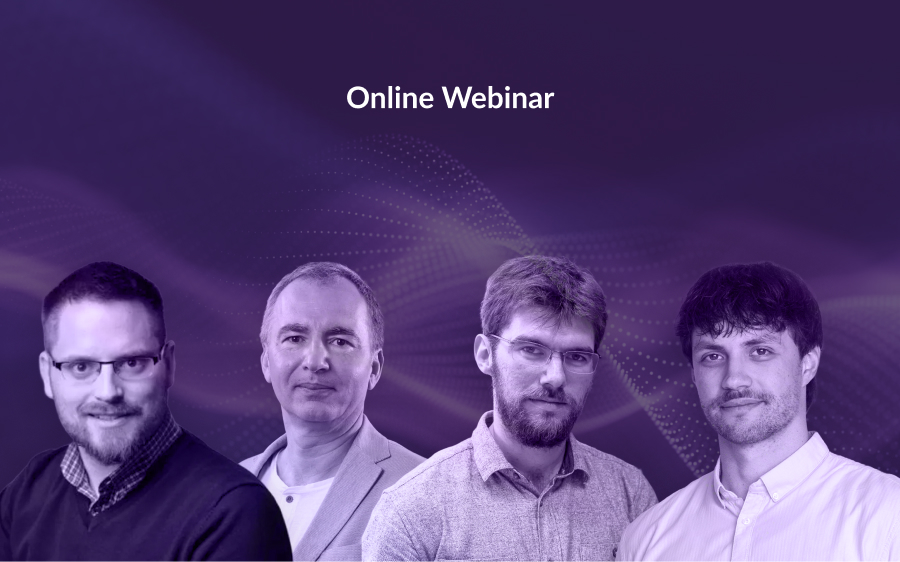
From Lab to Fab: Quantum Sensing & NV Control Webinar
February 4, 2026 | Join the "From Lab to Fab" webinar series on quantum sensing, and learn about exciting breakthroughs in quantum sensing applications using NV centers.
The GIRAFFE Consortium and NV-Center Gyroscope Technology
GIRAFFE stands for Gyroscopes for Autonomous Flight, Driving, and Flight Assistance and its consortium was led by Silicon Austria Labs and included partners such as Infineon, the University of Stuttgart, Beyond Gravity, AVL and Cosylab.
Its goal was to transfer NV-center-based quantum gyroscope technology out of the lab and demonstrate its applicability in real-world conditions.
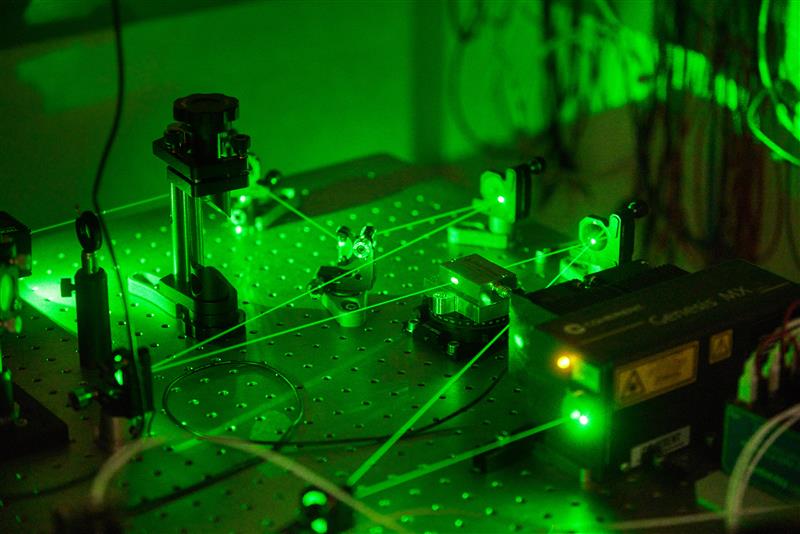
NV centers are atomic-scale defects in diamonds, formed when a nitrogen atom replaces a carbon atom next to a vacancy. These centers exhibit quantum properties that change with their orientation in space.
By shining a laser on an NV center and measuring phase shifts after rotation, it is possible to determine spatial orientation with extreme precision.
While this measurement principle has been demonstrated in laboratories many times, Cosylab’s role was to make it suitable for deployment by developing robust embedded control electronics.
Embedded Quantum Control Architecture for Industrial Systems
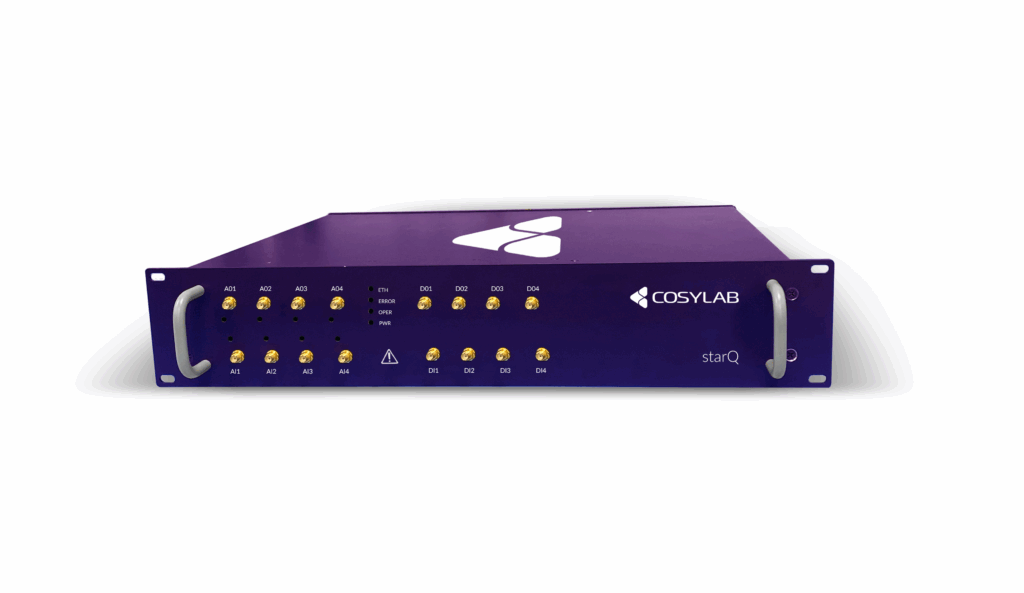
As part of the GIRAFFE project, we developed the firmware and software required to control the NV center using a specialised FPGA-based RFSoC, forming a complete embedded quantum control architecture designed for real-time operation
The control system was designed in three layers.
The first layer handles signal generation—the “voice” of the system that communicates with the diamond. With integrated RF, we achieved bandwidths of up to 3.5 GHz, providing the fidelity required to run quantum control protocols.
The second layer handles real-time data processing, enabling real-time control for quantum systems by interpreting information coming back from the diamond on the fly.
The third layer manages timing and coordination. This layer acts as the conductor of the system, ensuring all operations occur with nanosecond precision. Deterministic timing is crucial for robustness and repeatability, especially when designing industrial quantum sensing systems intended for deployment outside the laboratory.
By embedding all three layers onto a single board, we created a compact, deployable quantum control system.
Performance Results and Industrial Readiness
The resulting quantum gyroscope demonstrated approximately a 2,000-fold improvement in accuracy compared to conventional MEMS gyroscopes.
Traditional gyroscopes can drift by around 20 kilometres in over 10 minutes. In contrast, this quantum gyroscope reduced drift to roughly 10–100 meters. This level of performance makes quantum gyroscopes practical for autonomous navigation, aviation, and other demanding applications.
For example, this accuracy enables GPS-free navigation systems for autonomous vehicles working in environments where satellite signals are unavailable or unreliable.
Key Lessons for Quantum Technology Commercialisation
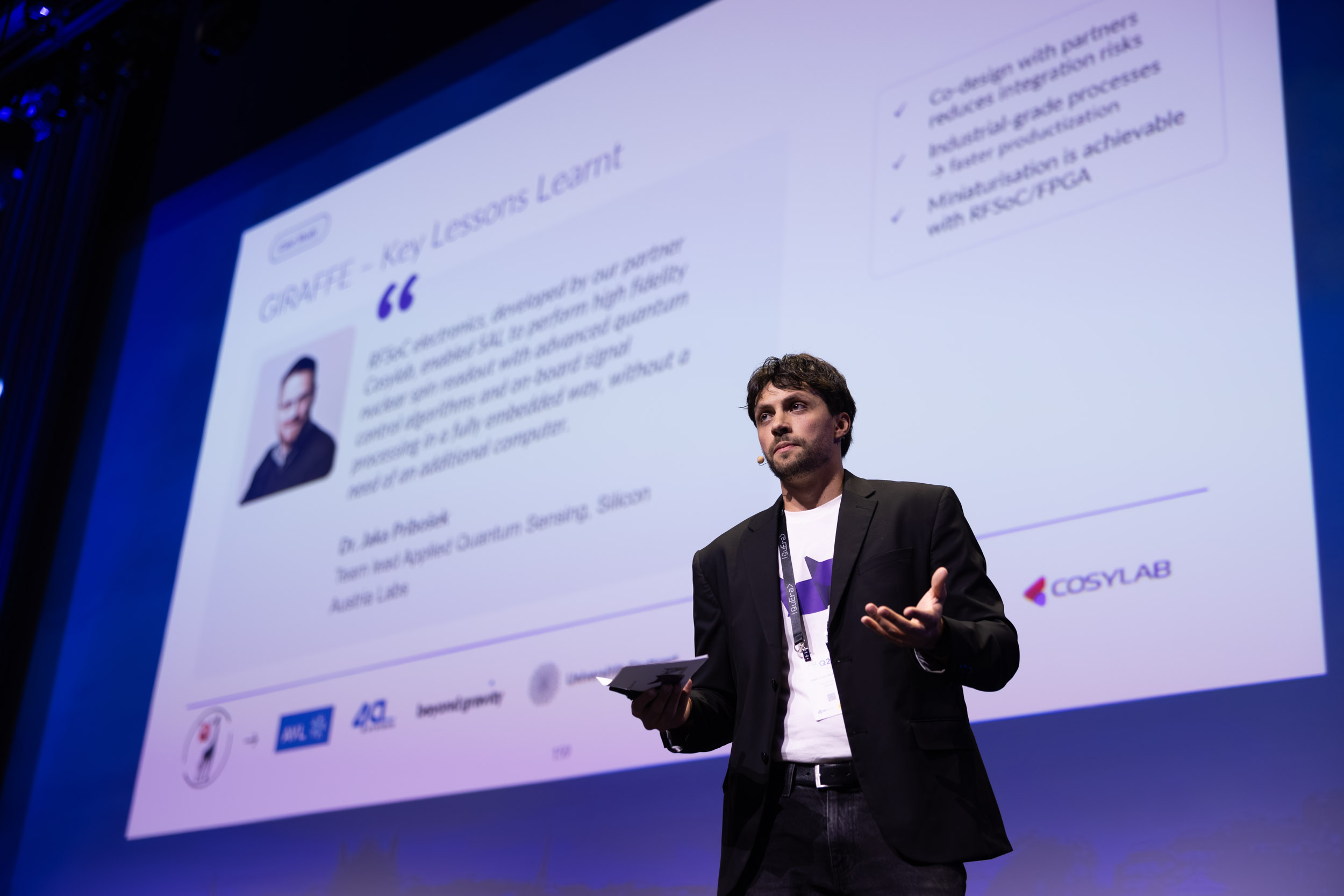
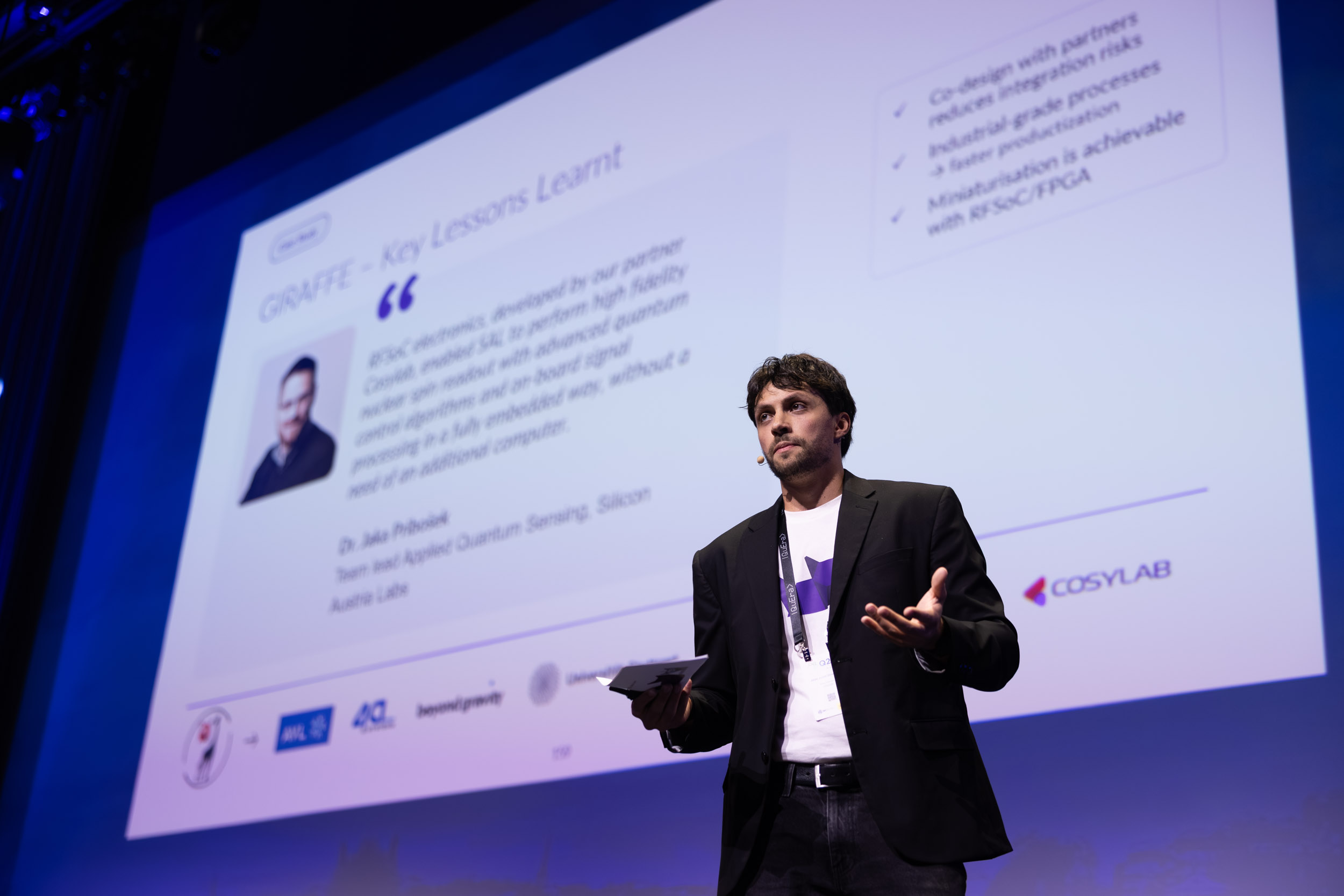
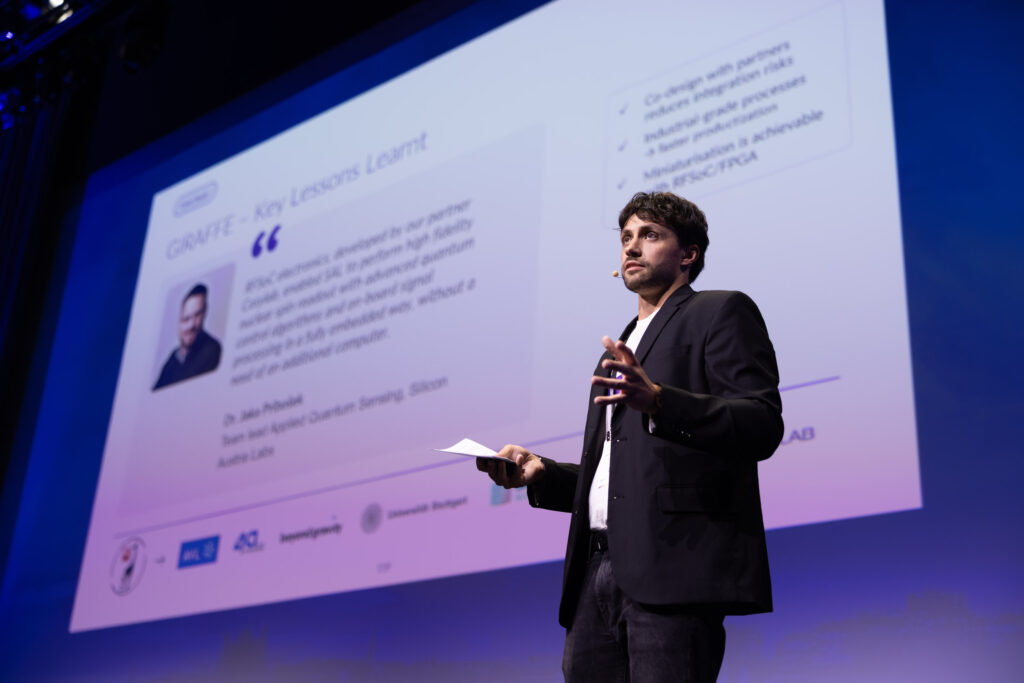
One of our partners, Dr Jaka Pribošek from Silicon Austria Labs, highlighted that the platform enabled high-fidelity nuclear spin readouts without the need for an external computer because all critical functions were embedded.
Three key lessons emerged.
- First, embedding all critical functions reduces system complexity. Fewer connections and moving parts mean fewer failure points and improved robustness.
- Second, embedding enables miniaturisation, making the system smaller and better suited for deployment outside the lab.
- Third, designing the system architecture for industrialisation from the very beginning significantly reduces integration risks and eliminates the need for costly redesigns later in the development cycle.
Advancing Quantum Gyroscopes from Research to Industry
Building a quantum gyroscope that works outside the lab requires more than scientific accuracy, as it also demands robust embedded control systems, deterministic timing, and an architecture designed for industrialisation from day one.
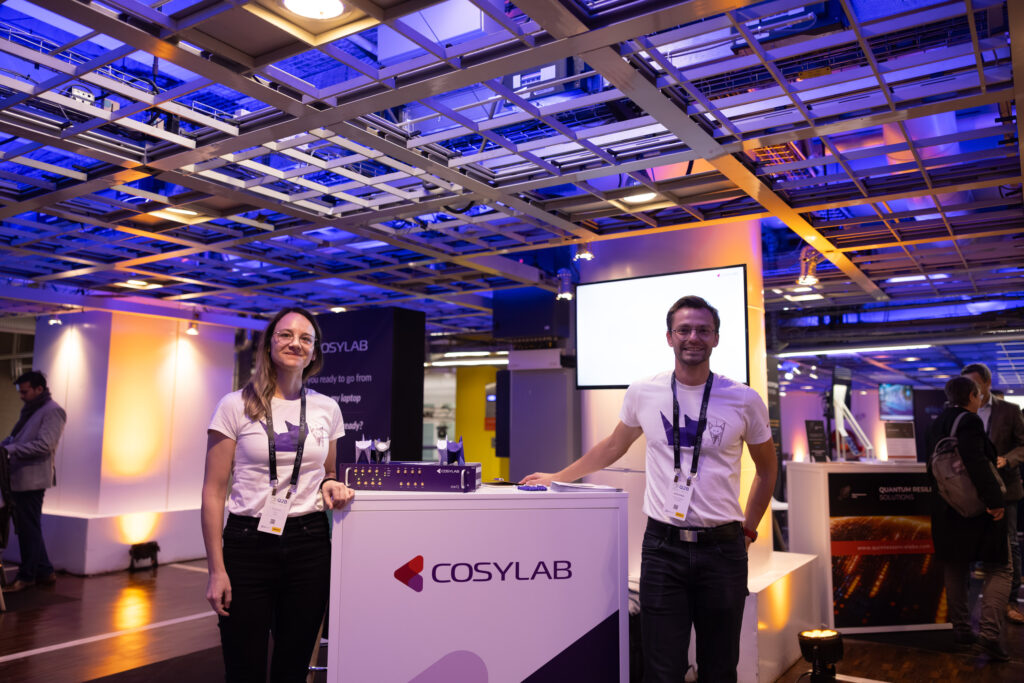
At Cosylab, we regularly work closely with quantum startups and research labs, and companies developing proof-of-concept and MVP systems. We specialise in designing custom control systems and embedded electronics for complex machines, including quantum sensing and quantum technology platforms.
If you are working on a quantum gyroscope, quantum sensor, or another advanced quantum system and are looking to bridge the gap between research and real-world deployment of a product-ready solution, feel free to get in touch!
About This Talk
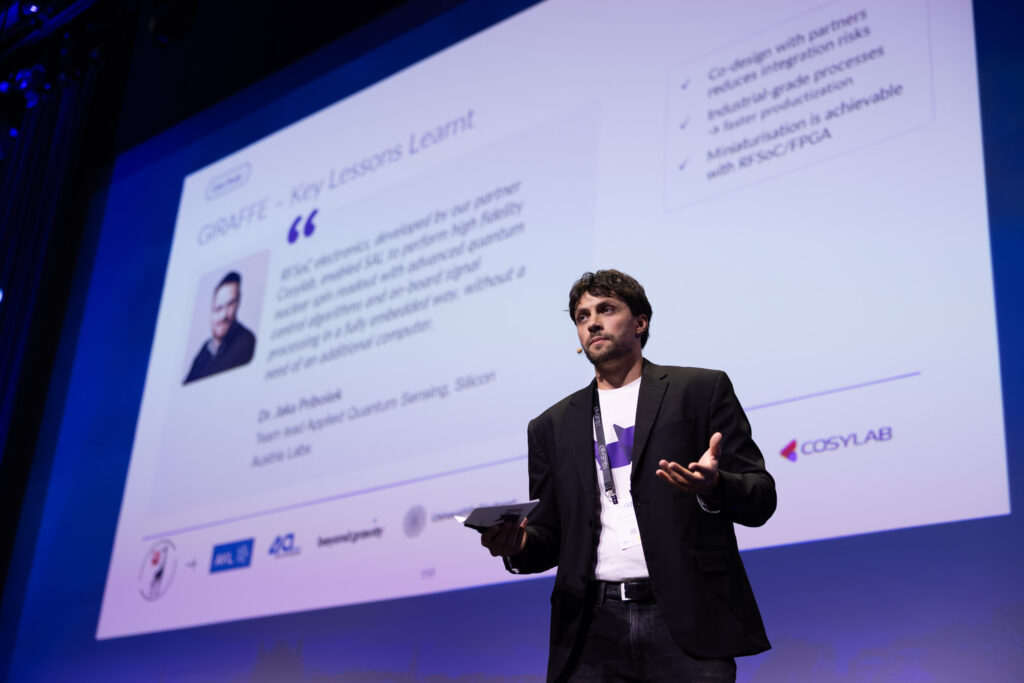
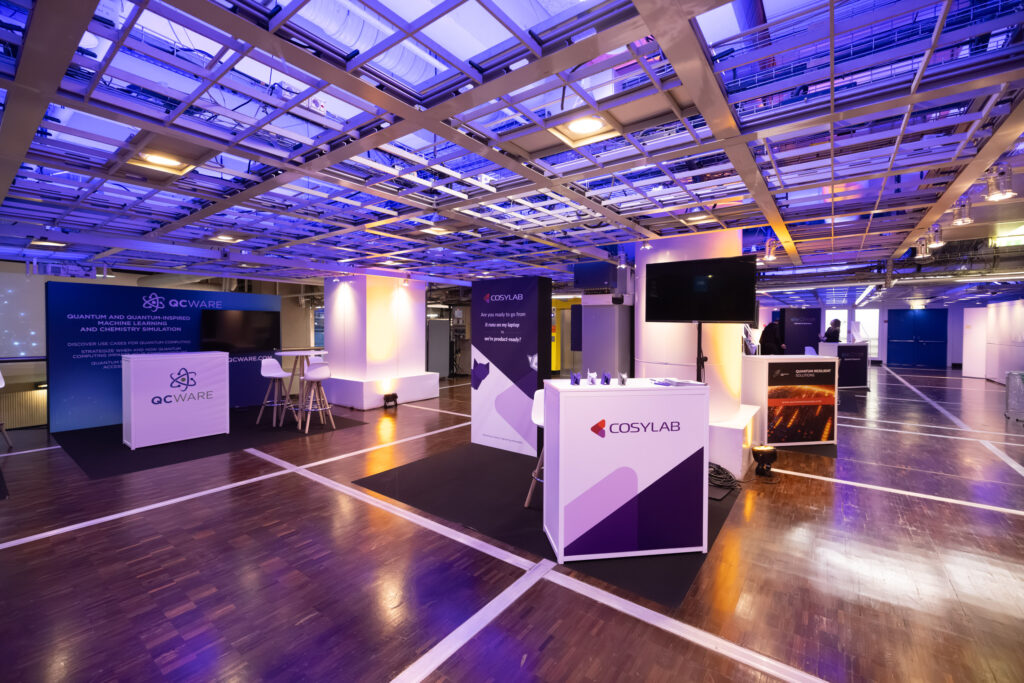
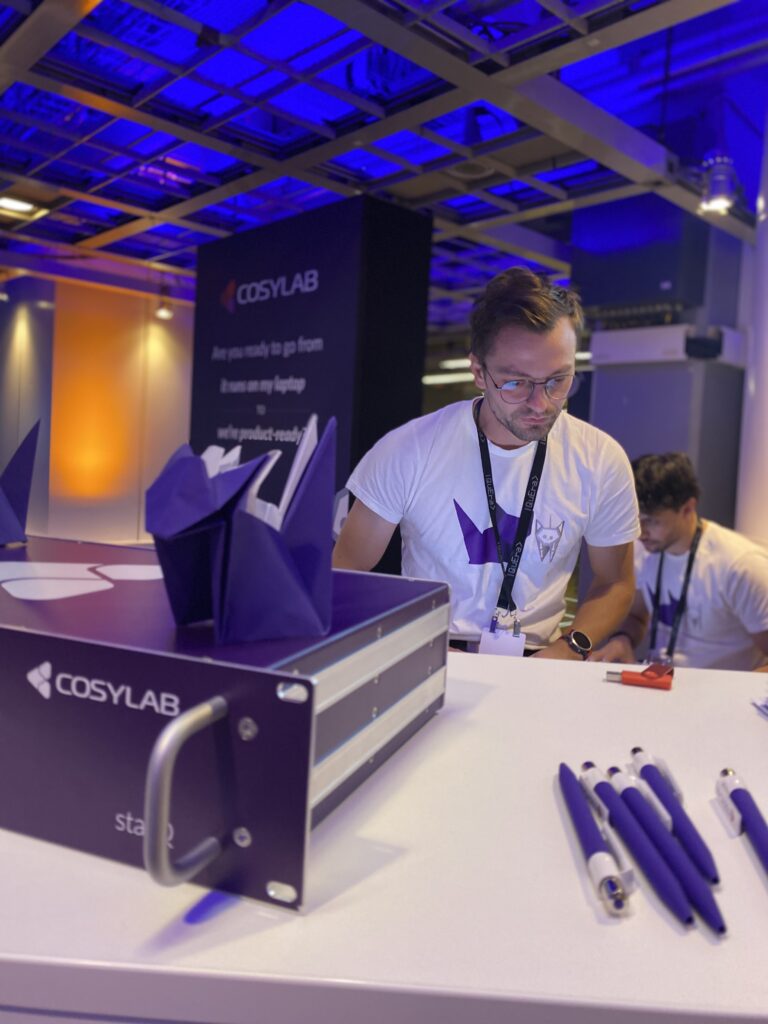
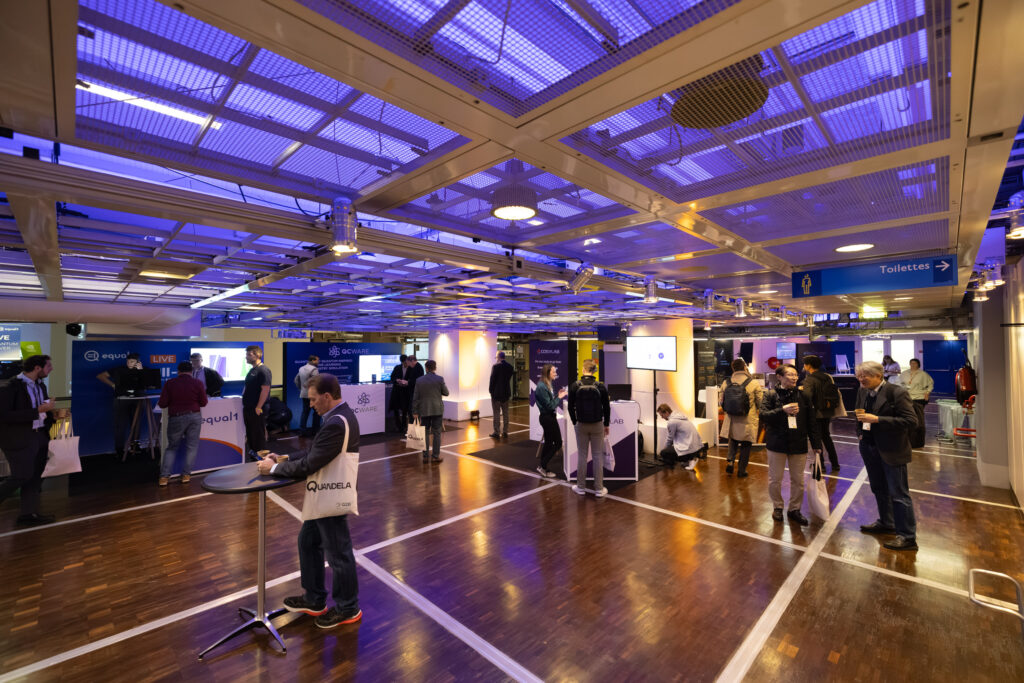
This blog is based on Cosylab’s presentation at the Q2B (Quantum Technologies Conference in Paris), delivered by Jean Josef Strouken, who shared practical lessons from our work within the GIRAFFE project about our deployment of quantum sensing technologies from laboratories into real-world environments.
This project was funded within the framework of Quantum Austria by the Austrian “Nationalstiftung für Forschung, Technologie und Entwicklung” (National Foundation for Research, Technology and Development), the FFG and FWF, with support of the Federal Ministry for Science and Research (BMBWF)


FAQ
What is a quantum gyroscope, and why is it important for navigation?
- A quantum gyroscope is a sensing device that uses quantum mechanical principles to measure rotation and orientation with exceptional precision. Unlike traditional sensors, it doesn’t rely on mechanical parts and can maintain accuracy over long periods without drifting.
What’s the difference between MEMS gyroscopes and quantum gyroscopes?
- Micro-Electro-Mechanical Systems gyroscopes are small mechanical sensors commonly used in devices such as smartphones and cars. They suffer from drift over time, which limits their accuracy for extended use. Quantum gyroscopes, on the other hand, leverage quantum effects (such as those in NV-centres) for far superior stability and precision, often 2,000 times better.
What are NV-centers and how do they work in quantum sensing?
- NV-centers are atomic defects in diamond crystals, where a nitrogen atom replaces a carbon atom adjacent to a vacancy. They exhibit quantum properties that respond to changes in magnetic fields or orientation. In sensing, a laser excites the NV-center, and the resulting phase shifts are measured to determine precise spatial data.
What is embedded control architecture, and why is it beneficial for quantum systems?
- Embedded control architecture integrates hardware and software directly into a device for real-time operation, often utilising components such as FPGA-based RFSoCs. In quantum systems, it ensures deterministic timing, reduces complexity, and enables miniaturisation.
What are the main challenges in industrialising quantum technology?
- Industrialising quantum tech involves transitioning from lab prototypes to robust, scalable systems that lessen the risk. Among common hurdles are over-reliance on expensive off-the-shelf components, coordinating multiple providers, or building internal teams under tight deadlines.
From Lab to Fab: Quantum Sensing & NV Control Webinar
February 4, 2026 | Join the "From Lab to Fab" webinar series on quantum sensing, and learn about exciting breakthroughs in quantum sensing applications using NV centers.