


Maintain Delivery Speed and Reliability Under Pressure
Maintain Delivery Speed and Reliability Under Pressure
7. May 2026
min read
Blog
Semiconductor
Development teams at semiconductor equipment manufacturers experience an all-too-familiar constraint: time-to-deliver is shrinking as the complexity of each tool increases. No longer can a team build a tool that can only be run on a lab bench, but it must now also interface with a fab environment, adhere to specific regulatory and safety standards, and have built-in upgrade capabilities.
Our SEMICON Europa 2025 industry survey results showed the collective constraints that impede reliable forecasting of delivery timelines. Among others, these include last-minute regulatory/compliance issues, growing technical debt, increased time spent integrating new products into existing environments, and additional pressure from onboarding new design talent.
The following blog represents the first in a three-part series based on the aforementioned survey. In it, we discuss what differentiates teams that successfully deliver their product from those that find themselves in an endless loop of rework and schedule delays.
Predictable Progress in Engineering
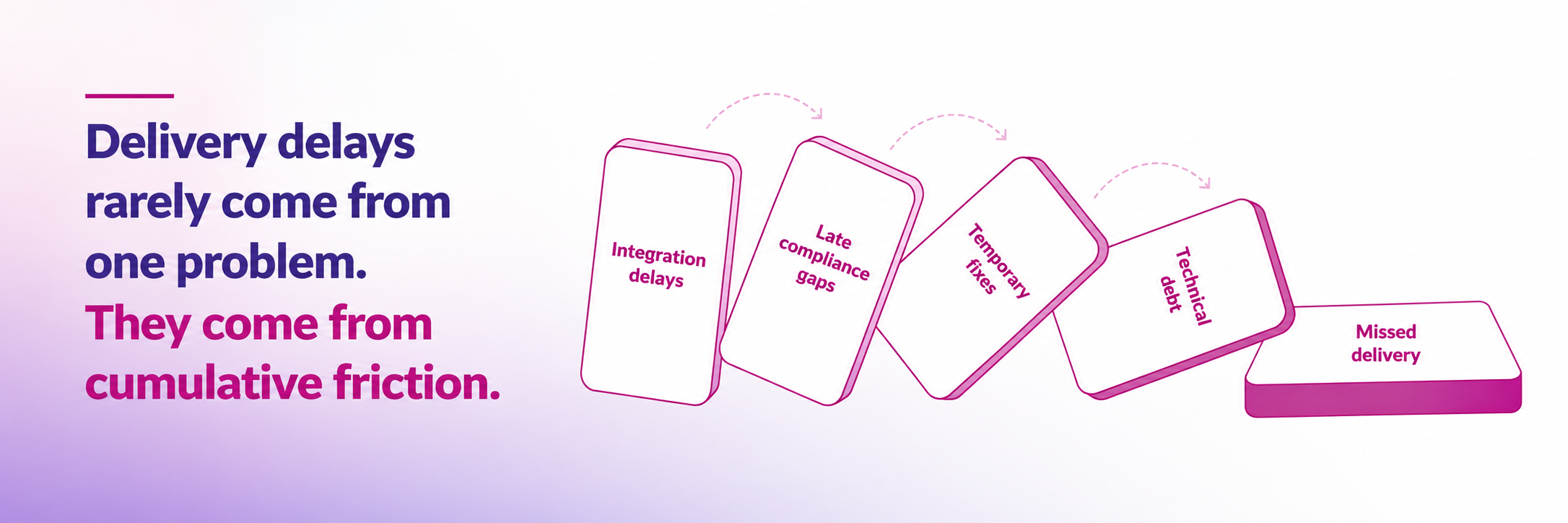
When delivery reliability falls short of expectations, it is rarely due to a single technical problem.
Instead, it results from the cumulative effects of friction: integration activities that take longer to complete than anticipated, last-minute compliance gap issues that require changes to the design and/or functionality of the tool, temporary fixes that become permanent, and a large amassment of technical debt that causes each subsequent development cycle to be slower than the previous one.
One thing that was very evident in the qualitative survey responses from engineering teams was that most were not looking for miracles but for predictable progress on their projects.
They wanted to maintain a consistent development cadence that did not fall apart under the burden of integration and compliance work. This means that speed is no longer simply a project management objective; it is also an engineering objective that depends on your system’s configuration and the maturity of your integration strategy.
The critical transition point is that delivery speed is now a systems characteristic. The tools that ship reliably tend to share several common attributes.
These include treating fab integration and compliance as engineering inputs from the beginning of the design process, rather than as documentation added after design completion. Another attribute is investing in traceability and observability at a point in the design process that enables debugging behaviour without resorting to guesswork.
Finally, we can identify where deterministic behaviour matters in the device, then build the control system so timing, precision and safety are appropriately designed, verified, and repeatable.
Minimising Custom Integration
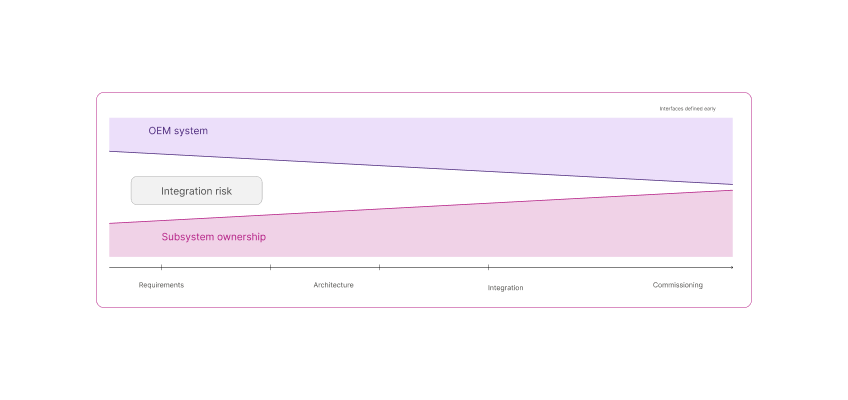
A simple way to protect delivery speed is to minimise the amount of custom integration that works only in your laboratory and maximise the percentage of integration that is repeatable, testable, and transportable across different environments.
The latter does not necessarily mean over-designing the system. It is about being disciplined in the right areas: establishing clear contracts between subsystems, defining the appropriate boundaries of ownership, and establishing verification strategies that do not rely on heroic, on-site debugging at the worst possible time.
The payoff is not only fewer last-minute surprises but also fewer interruptions to your core team’s momentum. When connectivity, safety, and compliance requirements are integrated into the tool’s architecture, the risks associated with development decrease.
When you can demonstrate how a tool behaves rather than discover it during commissioning, you will have something rare in modern tool development: confidence in your schedule.
Subscribe to our newsletter
Get the latest insights on advanced systems engineering and control software for complex semiconductor systems.
Discipline and Sequence
In essence, maintaining control over delivery cadence depends on how a manufacturer can apply discipline and sequence. The cost associated with discovering compliance or connectivity issues grows exponentially as the team approaches the final stages of integration and qualification.
Teams that identify fab integration/compliance requirements early on, define how data flows within their system, determine which safety assumptions are valid, and ensure proper traceability throughout their system will eliminate the need for expensive redesigns that ultimately damage project schedules.
SEMICON Europa 2025 survey respondents concur that speed is not valued by teams in the absence of predictable progress. When an integration strategy reaches a level where the team can demonstrate a tool’s behaviour prior to commissioning rather than discover it during commissioning, engineers become more confident in scheduling outcomes.


Subscribe to our newsletter
What to Read Next
Get the latest insights on advanced systems engineering and control software for complex semiconductor systems.